The Machinery of Attention: How Modern Life Rewires the Human Signal

Subtitle: How systems capture, condition, and reshape the modern mind.
I. The Opening Fracture
Attention is the most contested territory of the modern world.
Not land.
Not ideology.
Not belief.
Attention — the human signal itself.
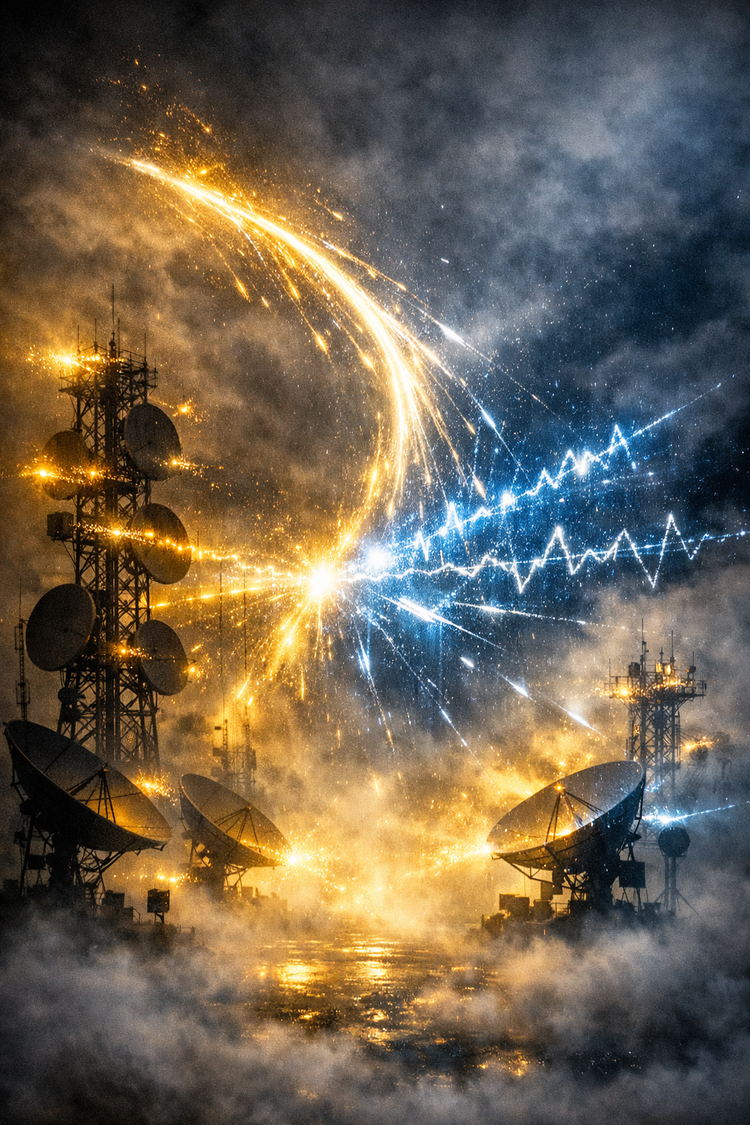
Every system that seeks influence — political, commercial, cultural, technological — begins by shaping what we look at, what we return to, what we cannot ignore.
The machinery is everywhere, and it is invisible by design.
Pull‑quote: “The machinery is everywhere, and it is invisible by design.”
II. The Economy of Glance
Attention was once a natural resource: abundant, renewable, self‑directed.
Now it is a commodity — extracted, refined, and sold.
The platforms do not ask what you want.
They ask what will keep you here.
They do not measure truth.
They measure retention.
The machinery does not care what you believe.
Only that you continue to believe something.
III. The Architecture of Pull
Modern influence systems operate through three mechanisms:
Frictionless Capture
The easier it is to look, the harder it is to stop.
Predictive Resonance
Systems learn what you return to, then amplify it until it becomes a loop.
Emotional Voltage
High‑charge content travels fastest — outrage, desire, fear, belonging.
Together, these mechanisms form a closed circuit:
capture → amplify → reinforce → repeat
Pull‑quote: “The easier it is to look, the harder it is to stop.”
IV. The Collapse of Boredom
Boredom once served as a cognitive reset — a clearing of the internal field.
Now it is treated as a failure state.
The machinery fills every gap.
Every pause.
Every moment that once belonged to you.
We have lost the ability to be unoccupied —
and with it, the ability to notice what is shaping us.
V. The Persuasion Loop
Influence no longer arrives as argument.
It arrives as environment.
You do not receive a message.
You inhabit one.
The loop is simple:
You act
The system responds
You adjust
The system adapts
You converge
This is not persuasion.
This is conditioning.
VI. The Human Signal Under Pressure
The machinery does not merely capture attention.
It rewires it.
Shorter cycles
Higher volatility
Lower thresholds for stimulation
Increased dependence on external cues
The human signal becomes fragmented —
a constellation of micro‑responses rather than a coherent beam.
VII. The Counter‑Architecture
To resist the machinery, one must build a counter‑architecture:
- deliberate slowness
- intentional boredom
- signal fasting
- cognitive sovereignty
- reclaiming the unobserved moment
Attention is not a resource to be protected.
It is a sense to be restored.
Pull‑quote: “Attention is not a resource to be protected — it is a sense to be restored.”
VIII. Closing Line
The machinery is powerful, but not absolute.
What it captures can be reclaimed —
once you remember that attention is not merely what you look at,
but the force by which you choose to see.